
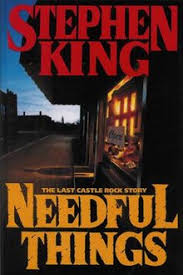
Rating: 9.5/10
This story is about a shop where people can buy anything they want with a small price and a deed that’s to be done, and I can already guess that the shopkeeper is the devil or the devil’s servant. It’s a relatively simple idea to think of, but King can take these generic ideas and turn them into an in-depth character/plot driven tales. That is exactly the case with Needful Things.
A quarter of the pages have been character building; just classic set up the stones and let them roll. There are a good amount of characters, which is why so much length of the book is took up to build them. As their personalities and doings were revealed, you can kind of see King putting labels on them. Those who are weak, either physically or emotionally, are the victims. Those who are aggressive and hot-tempered are the perpetrators who will later probably be blazing before going dead for good. Those who are charismatic are the heroes who will either sacrifice at the end or be the last ones standing. Lastly, the one and only, mysterious Mr. Gaunt, is the villain who is stirring the big mess up in this small town.
Here’s a brief summary of the book (detailed plot farther down). The antagonist, Leland Gaunt, is a demon who has been traveling around the world for centuries selling things in exchange for people’s souls. He made his next stop in Castle Rock, a relatively small town, and opened up a store called Needful Things. He offered people exactly the item they wanted in exchange for a small deed they have to do, which he will tell them about later. These deeds create conflicts between people, which build up an unstoppable storm of violence that our hero officer Pangborn has to stop before it destroys the entire town.
The book itself can be boring in the beginning, especially with the introduction of the setting and a huge number of characters, but it’s worth the wait because of the chain reaction that happens later on due to their personalities and relationships between each other. With that being said, it is expected that this book has a long, exciting build up and a big climax, and it has exactly that; all the characters that are active in the story keeps you on the edge about what’s going to happen next, and what happens next always surprises you and makes you think, “How worse can this get? What is it leading up to?” Once you’re familiar with how events happen, you’ll get the big picture (this is where you say “oh no” or “oh shit”). The climax is one of the longest I’ve ever seen in a book, which I like very much, but you might be numb to it after a while.
King tells this story in spectacular perspectives. You get to see how Leland Gaunt, or the devil at this point, turns old grudges and slight dislikes between people into full out rage and hatred. You get to see how at certain times, multiple events happen, as if you’re watching the town from above. Not only do you see the town as a whole, King also allows you to dive deep into people’s memories and thoughts, which is also a big selling point of the book.
More details regarding the plot if you don’t mind spoiler:
The first incident is between Nettie Cobb and Wilma Jerzyck. Nettie came home to find her dog killed. Wilma came home to find her blankets smeared with dirt. They both thought the other must have done it when it fact, those pranks were done by Brian Rusk and Hugh Priest, who did them in exchange for the item they bought from Gaunt. This resulted in Nettie and Wilma fighting each other to death on the street. All the accidents later happened just like this one: two people or groups of people, who already have some sort of inherent conflict each other, are tricked into fighting each other. The people who tricks them are always doing it in exchange of an item they buy from Leland Gaunt. Gaunt’s so called “harmless” pranks led up to a total disaster in Castle Rock: gym coach Lester Pratt beats deputy John LaPointe beyond recognition, Lester later gets shot in the skull, Hugh Priest and Henry Beaufort kills each other in a bar shootout, Brain Rusk puts a bullet through his own head out of the guilt for causing the Nettie-Wilma incident, town selectman Danforth Keeton attacks deputy Norris Ridgewick before smashing his own wife to death with a hammer, a group of Christians engages in war with a group of Baptists, and finally, Keeton and Ace Merril blows up most of the town with planted dynamites.
Personal theories(contains spoiler)
When I read to the part where Gaunt changes his eye color, a bell instantly rang in my head: in Drawing of the Three, Eddie’s eye color changed from blue to hazel when Roland entered his mind, so Gaunt could have multiple people existing in the same body. Upon further reading, I came up with the theory that Gaunt’s eye colors represents desires of his customers because first, everyone sees a different color in his eyes. Second, Gaunt seems to know exactly what his customer wants. Third, Gaunt acts differently in front of different customers.
The one and only connection in this book is Alan Pangborn, who was the police officer in the Dark Half, so it is not surprising that he is the hero in this book who ultimately saves the town. The real interesting thing here is his final fight against Leland Gaunt, when he suddenly receives magical powers out of nowhere. He turns a toy snake into a real snake that bites Gaunt, shoots energy lasers, and shouts at Gaunt with a god-like voice. These seem awfully similar to the abilities Ralph has in King’s other book, Insomnia, which makes me believe that Pangborn, just like Ralph, is one of the Purpose, or precisely people who work for the god that gave them those powers. In Insomnia, Ralph defeated people who work for the Crimson King, the ultimate antagonist in King’s universe(kind of like Satan) and the enemy of whoever gave Ralph powers; therefore, I think Leland Gaunt is a minion of the Crimson King as well since he was defeated by similar powers.
 Stabley's Universal Stephen King Blog